Why back up a Windows server to BucketPilot Cloud
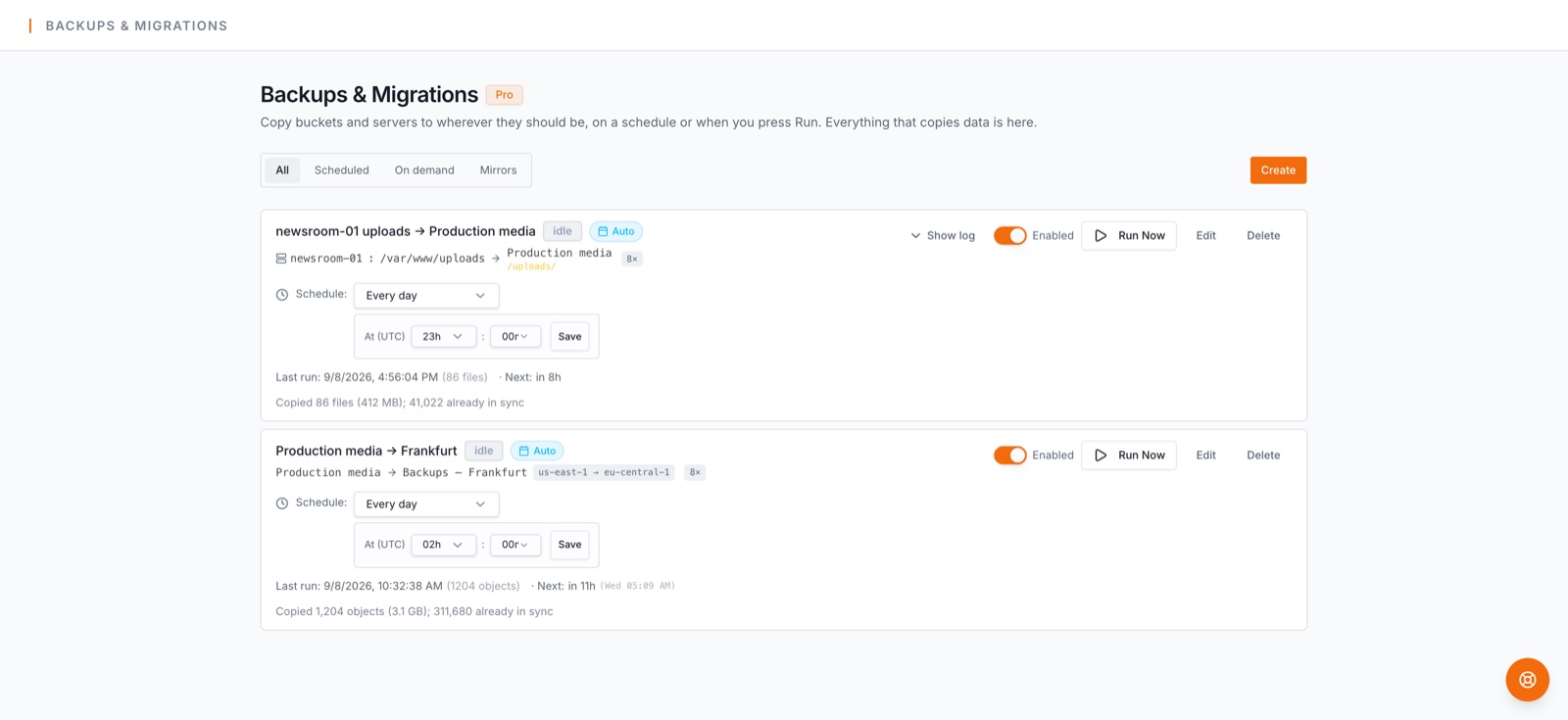
A Windows server is durable, but durable is not backed up: a deletion, an overwrite, a bad script or a lost credential all replicate perfectly. A backup is a separate copy — on BucketPilot Cloud — refreshed on a schedule and restorable from. That is what this job is.
Before you start
This job runs on the Pro plan and up. Every account starts with a 14-day Pro trial — no card needed; see plans.
Step by step
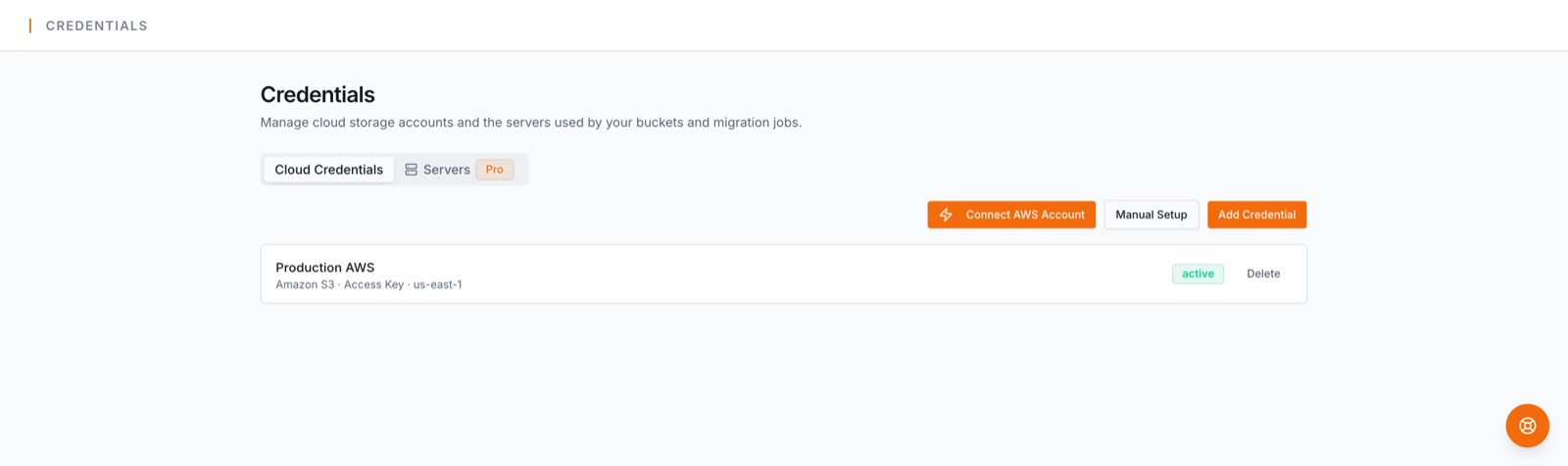
- 1.Connect the source. Enable the built-in OpenSSH Server on Windows (Settings → Apps → Optional features), then under Credentials → Servers add the machine with a user and its password or key. Paths are written the Windows way,
C:\Data\Exports, and BucketPilot connects from one fixed address, 3.111.107.194. - 2.Connect the destination. Nothing to connect. Under Buckets & Servers → Create Bucket, choose BucketPilot Cloud, pick a region (US, Europe or Asia Pacific) and a name, and the bucket exists in a minute — inside your workspace, with no keys to keep.
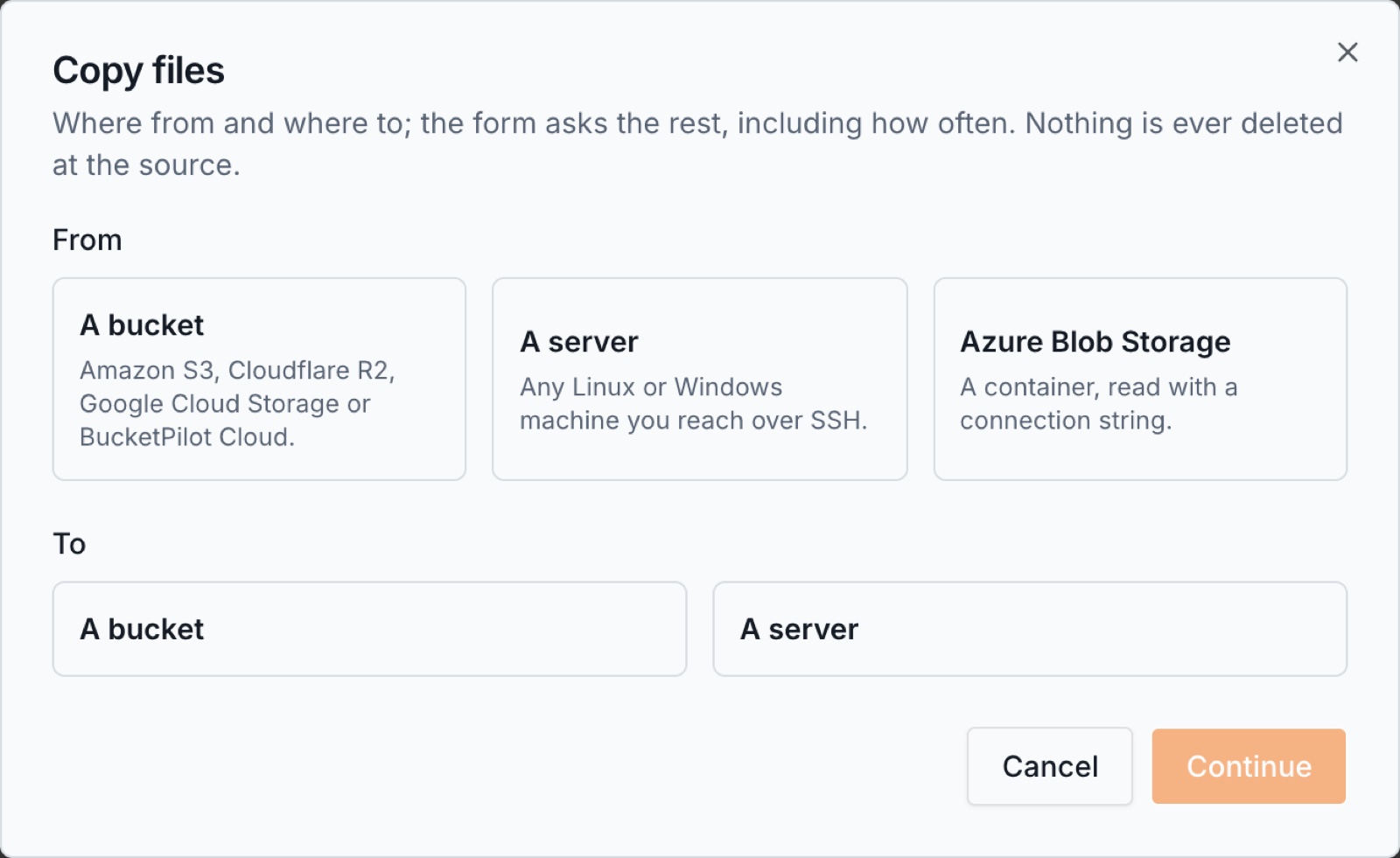
- 3.Open Backups & Migrations and press Create. Choose A server as the source and A bucket as the destination, then Continue.
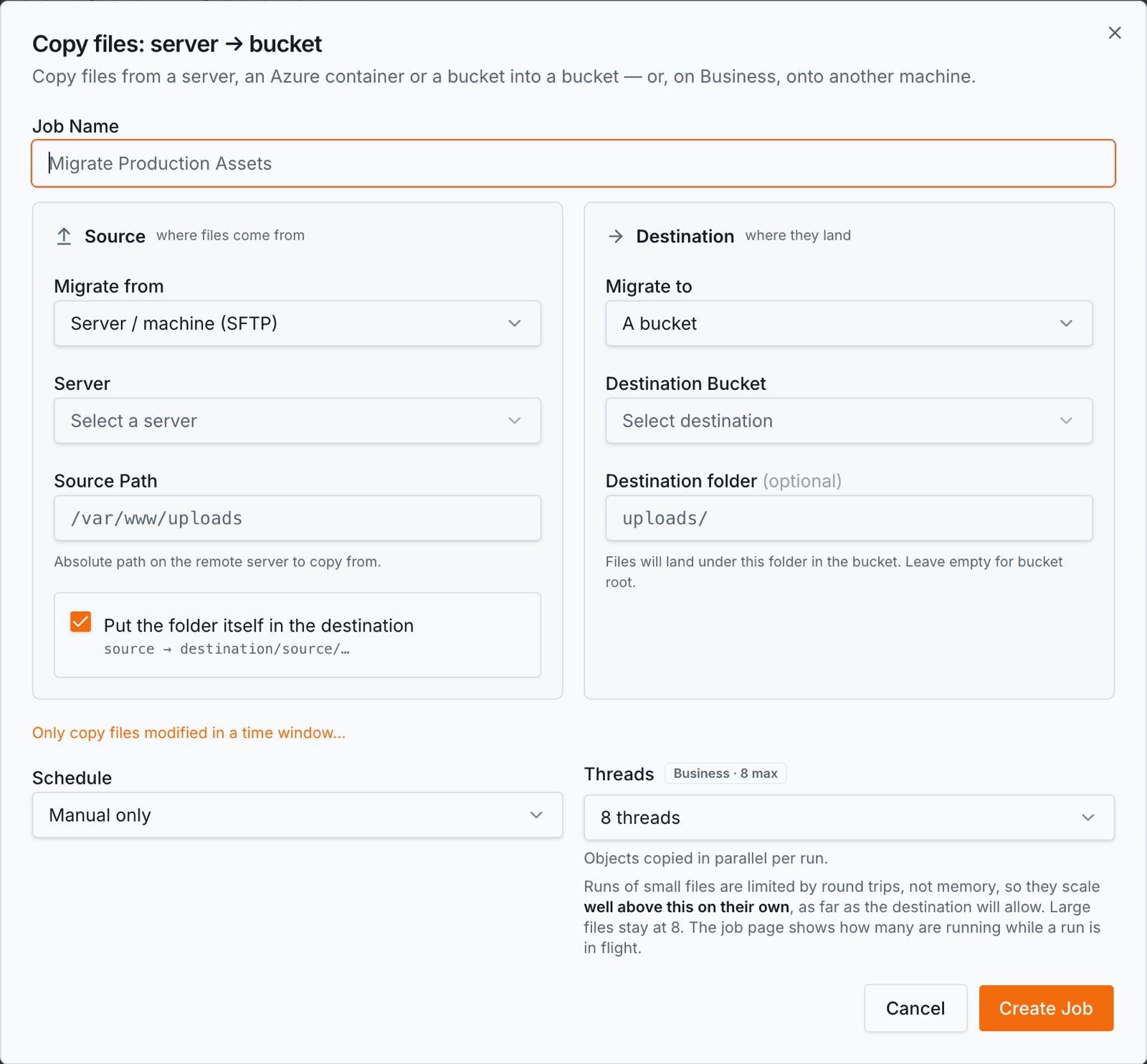
- 1.Pick the server and type the source path — the folder whose contents you want, for example
/var/www/uploadsorC:\\Exports. Tick *put the folder itself in the destination* if you want the folder name kept. - 2.Pick the destination bucket and, if you like, a folder inside it where the files land.
- 3.Set the schedule — hourly, daily, weekly or monthly, at the time you choose. Daily at night is the usual answer. Choose how many files copy in parallel (threads); eight is a good default for a busy server.
- 1.Press Create Job, then Run now. The first run copies everything; every run after it copies only what changed.
What happens on each run
Every run is incremental: a file is copied only if its size or timestamp differs from the copy, so a nightly run of a large source moves only the day's changes and finishes in minutes.
Files are streamed from source to destination — multi-gigabyte files never sit in memory, and a run that is paused or loses its worker resumes where it stopped.
You can watch it: live progress on the job, a per-file log, and an email when a run finishes or needs attention. Transient errors retry with backoff; a run that fails outright is reported, never silently skipped.
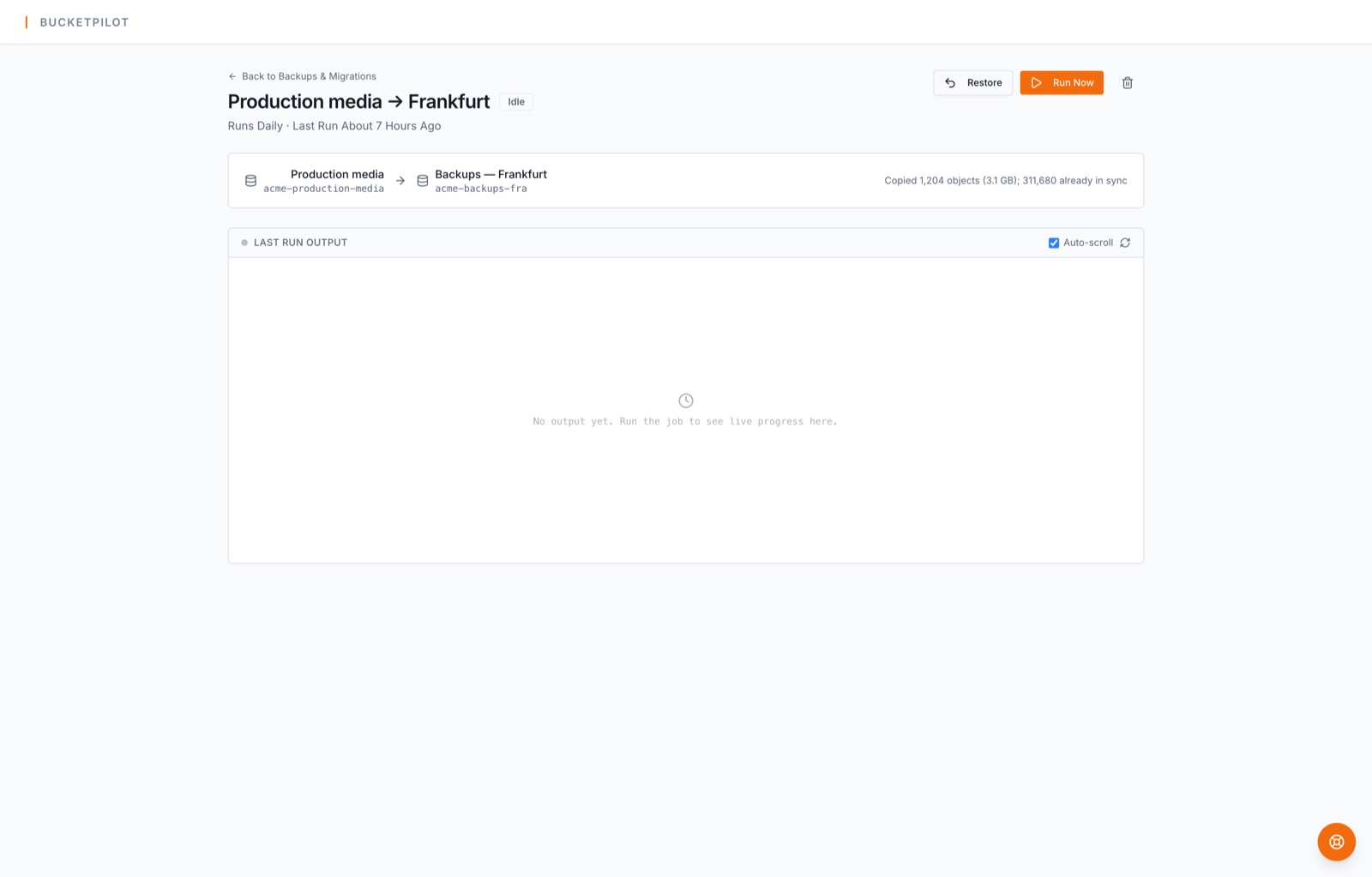
BucketPilot Cloud keeps every version of a file when versioning is on, and BucketPilot turns it on for a bucket it creates for a backup. A file overwritten or deleted by mistake at the source is still there in the copy, one click from restored.
What it costs
| Leaving your server | Your server's own bandwidth; nothing is billed by BucketPilot for it. |
| Storing at BucketPilot Cloud | BucketPilot Cloud is billed per GB-month on your BucketPilot invoice; every file counts as at least 4 KiB. |
| BucketPilot | Your plan; no per-GB fee for the copy itself. |
Getting files back
Every job has a Restore button: it copies from the destination back to the source, only what is missing there, never overwriting a newer file and never deleting anything. A backup you cannot restore from is not a backup, so this is part of the job, not a separate product.
Questions
- How often should I back up a server?
- Daily is the usual answer; hourly if the source changes all day. Runs are incremental, so a more frequent schedule costs little more than a rare one.
- What will it cost?
- Your server's own bandwidth; nothing is billed by BucketPilot for it. BucketPilot Cloud is billed per GB-month on your BucketPilot invoice; every file counts as at least 4 KiB. BucketPilot charges by plan, never per GB copied.
- What about very large files?
- Files are streamed in parts and resume after an interruption. Files of any size move to and from a server; single objects over 5 GB to a bucket are copied as one object today.
- Does BucketPilot keep my files?
- No. Your files are copied from your source to your destination and are not stored by BucketPilot. We keep metadata — names, sizes, timestamps — to run the job and to make the copy searchable. Credentials are encrypted at rest.
Related
- Docs: backup s3 bucket
- Docs: servers
- Docs: migrate sftp to s3
- Docs: jobs
- How to back up Amazon S3 to BucketPilot Cloud
- How to back up Cloudflare R2 to BucketPilot Cloud
- How to back up Google Cloud Storage to BucketPilot Cloud
- How to back up BucketPilot Cloud to another BucketPilot Cloud bucket
- How to back up a Linux server to BucketPilot Cloud
- How to migrate a Linux server to BucketPilot Cloud
Set up back up windows server to bucketpilot cloud today
Full Pro access for 14 days. No card. Connect an account in seconds.