Archives at scale
An archive is millions of small files nobody opens and thousands of large ones everybody needs. Cloud storage prices the two very differently, and the console you get from the provider will not tell you which is which. BucketPilot indexes the whole bucket — tens of millions of objects — and shows the archive by type, size, age and storage class, so decisions are made on numbers.
Finding one frame
Search by name with wildcards, filter by extension, size or date, across every bucket and server at once. The index refreshes on a schedule, so a search is never stale by more than a day, or an hour if you choose.
Paying the right price for each file
The savings finder names the files that could live on a cheaper class and what it would save. Lifecycle rules move them there on a schedule you set, and old object versions are counted so an archive with versioning on is not paying twice without knowing.
A second copy, somewhere else
A backup job copies the archive to a second bucket, another provider, or BucketPilot Cloud, on a schedule, incrementally. Cross-provider copies stream through BucketPilot; same-provider copies happen server-side. A mirror keeps an identical live copy on Amazon S3 when seconds matter.
Told before the bill is
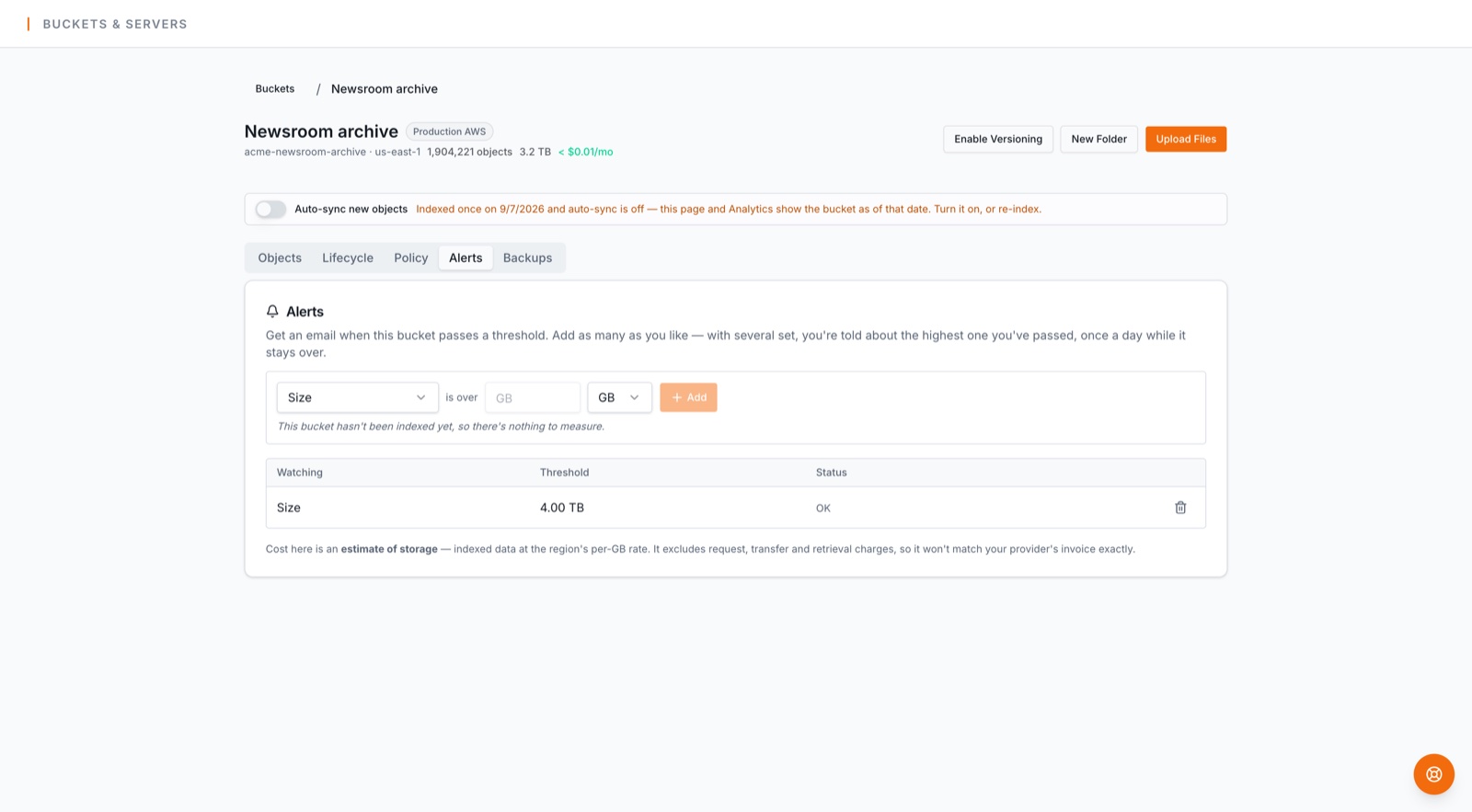
Set a size or cost threshold on any bucket — in GB or TB — and be emailed the day it is passed. Several thresholds make a ladder: a warning at 8 TB, a louder one at 10.
Questions
- How many files can BucketPilot index?
- Up to 50 million objects per account on the Business plan; the search stays fast at that size.
- Can it read an existing S3 Inventory report?
- Yes. A bucket that already produces S3 Inventory is indexed from the report instead of a walk, which is faster for very large buckets.
- Does moving files to a cheaper class change them?
- No. A lifecycle rule changes the storage class of an object in place; the file, its name and its versions are untouched.
Start with a guide
See it on your own buckets
Full Pro access for 14 days. No card. Connect an account in seconds.